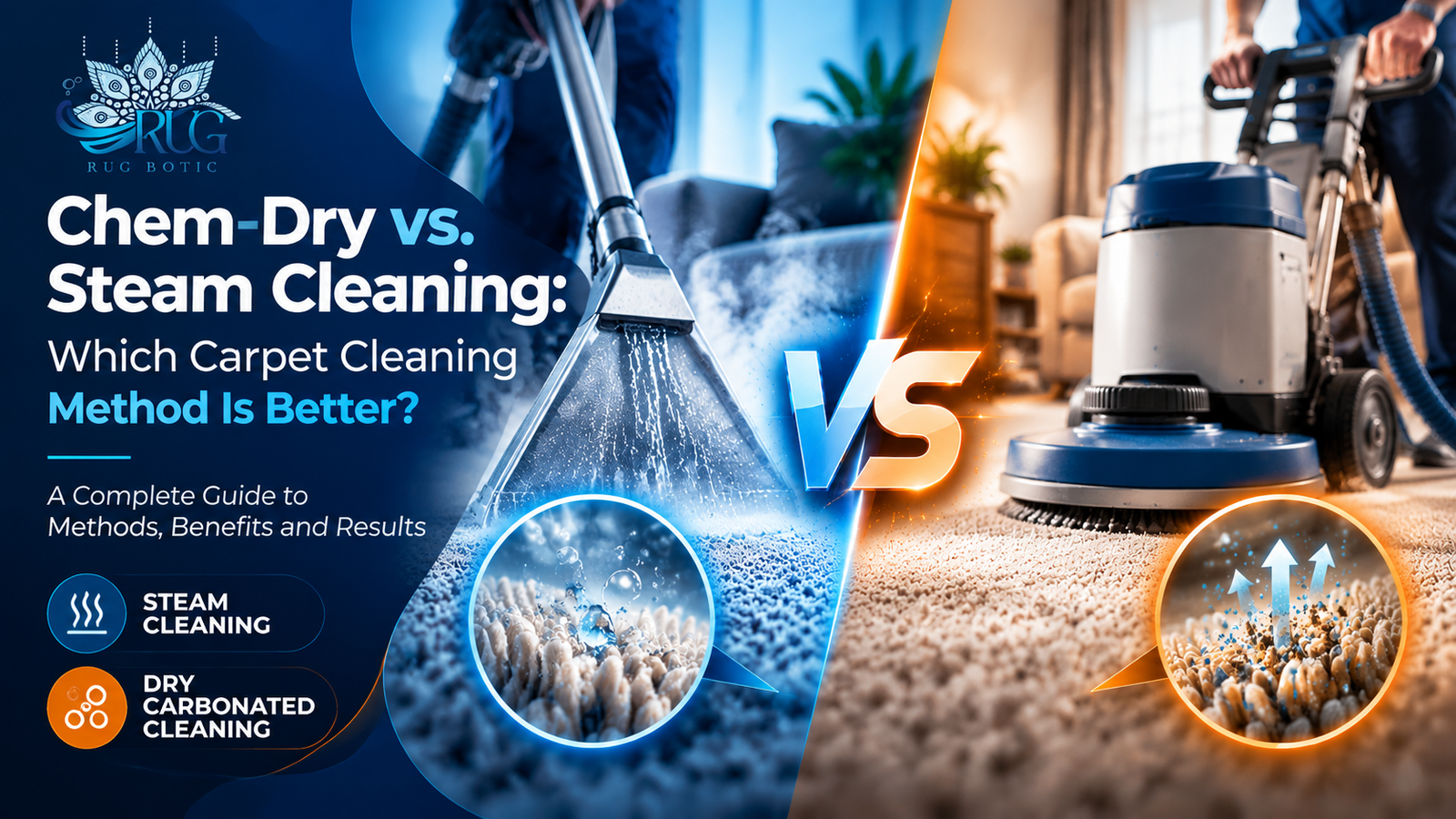
The main difference between Chem-Dry and steam cleaning is the cleaning process and amount of moisture used. Chem-Dry uses its Hot Carbonating Extraction (HCE) process with less water, while professional steam cleaning typically refers to hot water extraction, which uses heated water to loosen and extract dirt.
Which method is right for your carpet cleaning? It depends on factors such as drying time, carpet condition, and the type of dirt or stains. Continue reading to compare Chem-Dry vs steam cleaning and find out which method may be better for your home.
Chem-Dry vs Steam Cleaning: Key Differences
| Factor | Chem-Dry | Hot Water Extraction |
|---|---|---|
| Cleaning technology | Carbonating low-moisture extraction | Heated water application and extraction |
| Moisture level | Lower | Higher |
| Drying potential | Generally faster | Usually requires more drying |
| Deep soil removal | Process and soil dependent | Strong flushing and recovery potential |
| Stain removal | Relies on correct pre-treatment | Relies on correct pre-treatment |
| Pet odour | Requires contamination-specific treatment | Requires contamination-specific treatment |
| Residue | Depends on chemistry and process | Depends on chemistry, rinsing and extraction |
| Over-wetting risk | Lower moisture exposure | Higher if too much moisture remains |
| Equipment | Proprietary professional system | Truck-mounted or professional portable extraction |
| DIY equivalent | No true Chem-Dry DIY equivalent | Rental extractors exist, but differ from professional systems |
The useful comparison is not simply “wet versus dry”. Cleaning chemistry, agitation, extraction quality and technician skill influence the finished result.
Chem-Dry vs Steam Cleaning: How Each Method Works
How Chem-Dry Cleaning Works
A professional Chem-Dry treatment generally involves:
- Inspecting the carpet and identifying problem areas.
- Treating spots or stains where needed.
- Applying the carbonating cleaning solution.
- Working the solution through the fibres.
- Extracting loosened soil and moisture.
- Grooming the carpet and allowing it to dry.
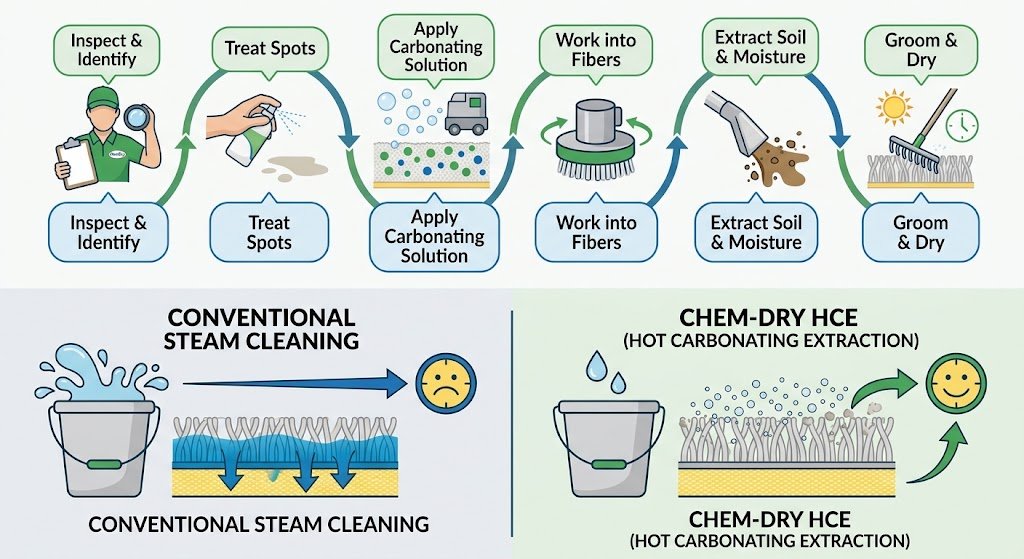
Chem-Dry describes HCE as using considerably less water than conventional steam cleaning, which is one reason the brand promotes faster drying as a feature of the system.
How Hot Water Extraction Works
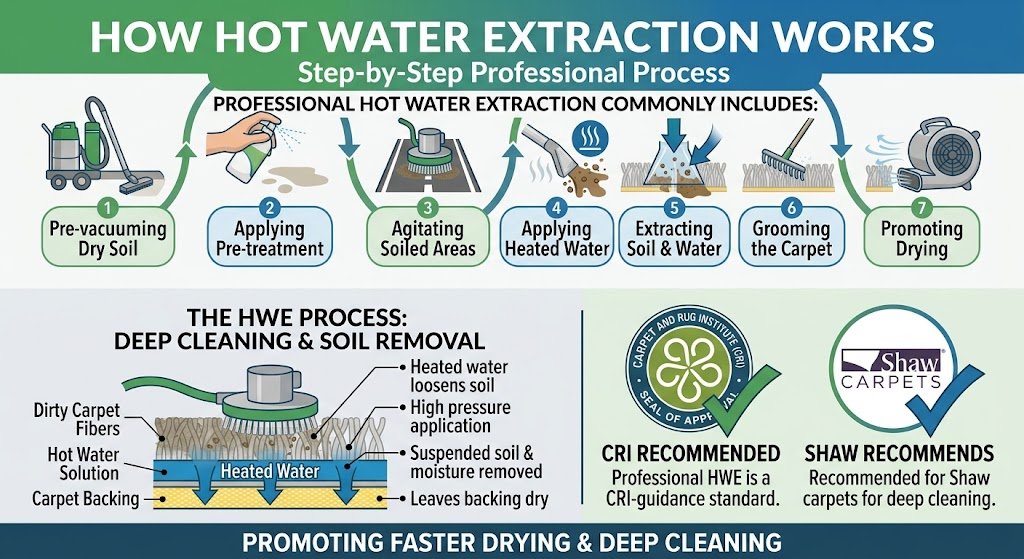
Professional hot water extraction commonly includes:
- Pre-vacuuming dry soil.
- Applying a suitable pre-treatment.
- Agitating heavily soiled areas where appropriate.
- Applying heated water.
- Extracting water, cleaning solution and suspended soil.
- Grooming the carpet.
- Promoting drying with ventilation or air movement.
The Carpet and Rug Institute includes hot water extraction within professional residential carpet-maintenance guidance, while Shaw recommends professional hot water extraction for its carpets.
Chem-Dry vs Steam Cleaning: Which Cleans Better?
Different cleaning needs favour different approaches.
| Cleaning Need | Method to Consider | Why |
|---|---|---|
| Routine soil | Either | Process quality matters |
| Heavy traffic soil | Hot water extraction | Strong flushing may help remove embedded soil |
| Quick maintenance | Chem-Dry | Lower moisture can make room reuse easier |
| Old stains | Professional assessment | Some staining may be permanent |
| Grease or oil | Either | Requires appropriate spot chemistry |
| Pet urine | Inspection first | Contamination may extend below the carpet |
| Heavy embedded soil | Hot water extraction | Often suited to more intensive extraction |
A machine alone does not determine cleaning performance. Pre-treatment, fibre compatibility and the way soil is suspended and extracted matter just as much.
Chem-Dry vs Steam Cleaning: Drying Time and Moisture
Lower-moisture cleaning normally has an advantage where fast reuse is important, but actual drying conditions vary from home to home.
| Factor | Chem-Dry | Hot Water Extraction |
|---|---|---|
| Moisture introduced | Lower | Higher |
| Drying requirement | Usually shorter | Usually longer |
| Quick room reuse | Often an advantage | Depends on extraction and airflow |
| Humidity sensitivity | Still relevant | Can have a greater effect |
| Prolonged dampness risk | Lower with correct use | Increases if carpet is over-wet or poorly extracted |
Drying is affected by:
- Indoor humidity
- Carpet thickness
- Underlay
- Ventilation
- Weather
- Air movement
- Amount of moisture applied
- Extraction efficiency
Chem-Dry publishes specific fast-drying claims for its own HCE system, but those figures should not be treated as universal drying times for every carpet or property.
Chem-Dry vs Steam Cleaning for Stain Removal
The type of stain usually matters more than the cleaning-method name.
| Stain or Soil | What Matters Most |
|---|---|
| Coffee | Correct pre-treatment and prompt cleaning |
| Wine | Stain chemistry and fibre/dye stability |
| Grease and oil | Suitable spotting treatment |
| Mud | Removing dry soil before wet treatment |
| Food stains | Identifying the stain before treatment |
| Traffic soil | Preconditioning, agitation and extraction |
| Old stains | Fibre or dye damage may be permanent |
| Pet urine | How deeply contamination has travelled |
Neither Chem-Dry nor steam cleaning should be expected to remove every old stain. A realistic assessment should come before treatment.
Chem-Dry vs Steam Cleaning for Different Carpet Types
Always follow the carpet manufacturer’s care instructions before choosing a professional carpet cleaning method.
| Carpet Type | Chem-Dry | Hot Water Extraction | Key Consideration |
|---|---|---|---|
| Nylon | Often suitable | Often suitable | Soil and manufacturer guidance |
| Polyester | Often suitable | Often suitable | Oil-based spots may need extra treatment |
| Wool | Specialist assessment | Can be suitable if approved | Heat, chemistry and agitation require care |
| Olefin / polypropylene | Often suitable | Often suitable | Soil type matters |
| Berber / loop-pile | Can be suitable | Can be suitable | Construction and drying matter |
| High-pile carpet | Depends on construction | Professional extraction may suit | Thorough drying is important |
A Note About Area Rugs
Valuable wool, silk, Persian, Oriental and hand-knotted rugs should not automatically be cleaned like installed carpet. They may require dye testing, fibre identification and specialist off-site rug cleaning.
Chem-Dry vs Steam Cleaning for Pet Stains and Odours
Pet urine can travel below the visible carpet fibres.
A technician may need to assess:
- Carpet surface
- Backing
- Underlay or pad
- Repeated accident areas
- Subfloor contamination
If urine has reached the backing or padding, whole-carpet cleaning alone may not address the complete odour source.
Chem-Dry vs Steam Cleaning for Allergens and Indoor Carpet Cleanliness
Neither method should be presented as a medical treatment.
For a cleaner carpet, focus instead on:
- Removal of dry soil and fine particles
- Pet dander removal
- Thorough extraction
- Appropriate cleaning chemistry
- Minimal unwanted residue
- Complete drying
Regular vacuuming remains important between professional cleaning appointments.
Chem-Dry vs Steam Cleaning Cost
There is no universal cheaper method.
| Cost Factor | Chem-Dry | Hot Water Extraction |
|---|---|---|
| Base cleaning | Provider and area dependent | Provider and equipment dependent |
| Stain treatment | May cost extra | May cost extra |
| Pet treatment | Often specialised | Often specialised |
| Large areas | More area increases cost | More area increases cost |
| Protectant/deodoriser | May be additional | May be additional |
| Main pricing variable | Area, condition and treatments | Area, condition and treatments |
For carpet cleaning in Orange County, compare quotes based on the same room size, stain treatment and service scope rather than the advertised starting price alone.
Chem-Dry vs Steam Cleaning: Pros and Cons
Chem-Dry Advantages
- Lower-moisture cleaning
- Faster drying potential
- Convenient for occupied homes
- Useful for routine or moderate cleaning
Chem-Dry Considerations
- It is a proprietary branded system.
- It is not automatically ideal for every contamination level.
- Severe pet contamination may require additional treatment.
- Technician execution still matters.
Hot Water Extraction Advantages
- Strong flushing and recovery
- Established professional method
- Suitable for substantial embedded soil
- Recommended by some major carpet manufacturers
Hot Water Extraction Considerations
- Introduces more moisture
- Drying can take longer
- Poor extraction can leave excess moisture
- Heat, chemistry and technique must suit the carpet
Is Chem-Dry Better Than Steam Cleaning?
Neither is universally better.
| Cleaning Need | Method to Consider |
|---|---|
| Lower moisture | Chem-Dry |
| Faster potential reuse | Chem-Dry |
| Heavy embedded soil | Hot water extraction |
| Strong flushing | Hot water extraction |
| Pet urine | Inspect contamination depth first |
| Delicate fibres | Manufacturer-approved method |
| Heavily soiled carpet | Fibre and soil assessment first |
Questions to Ask Before Booking a Carpet Cleaner
Ask the technician:
- What cleaning method will you use?
- Do you pre-vacuum?
- Is stain treatment included?
- How do you assess pet urine?
- What drying conditions should I expect?
- Is the process suitable for my carpet fibre?
- What is included in the quoted price?
- Do my carpet manufacturer’s instructions affect the method?
These questions often tell you more than choosing a company based purely on “Chem-Dry” or “steam cleaning”.
Chem-Dry vs Steam Cleaning: Final Comparison
| Category | Chem-Dry | Hot Water Extraction |
|---|---|---|
| Cleaning technology | Carbonating low-moisture extraction | Heated water extraction |
| Moisture level | Lower | Higher |
| Drying | Generally faster | Usually longer |
| Deep soil extraction | Process-dependent | Strong flushing potential |
| Stain treatment | Pre-treatment dependent | Pre-treatment dependent |
| Pet odours | Needs urine-specific treatment | Needs urine-specific treatment |
| Carpet compatibility | Fibre dependent | Fibre dependent |
| Routine cleaning | Strong use case | Suitable |
| Heavy cleaning | Situation dependent | Often a strong use case |
| Main advantage | Lower moisture | Intensive extraction |
| Main consideration | Not ideal for every contamination type | Moisture management |
For Orange County homes, the best carpet-cleaning method should be selected around the carpet fibre, soil level, pet contamination and manufacturer care instructions.
If you are unsure which approach suits your carpet, Rug Botic can assess the carpet and cleaning requirements before you choose a method.
Frequently Asked Questions
Does Chem-Dry really clean carpets?
Yes. Chem-Dry uses its HCE system to loosen and extract soil with a lower-moisture process.
Does steam cleaning use actual steam?
Usually not. The professional method consumers call steam cleaning is generally hot water extraction.
Which method dries faster?
Chem-Dry generally has faster drying potential because it uses less moisture. Actual drying varies with carpet construction, humidity and ventilation.
Which removes stains better?
Neither method automatically removes every stain. Correct stain identification, chemistry and pre-treatment are more important.